Some people come to us with an Irish tattoo they’ve been planning for years. A Claddagh for a grandmother from Galway. A shamrock for a first trip home. A trinity knot that matches their sister’s. Others walk up Capel Street on holiday and decide on the spot that Dublin deserves a permanent souvenir.
Either way, an Irish tattoo means more when you know what the symbol actually stands for, and it lasts longer when it’s designed properly for skin. This guide covers the meaning and history behind the Claddagh, the shamrock and the Celtic knots, the design ideas that work best, and what to know before you book one at XOXO Tattoo Studio in Dublin.
In This Guide
The Claddagh: Love, Friendship and Loyalty
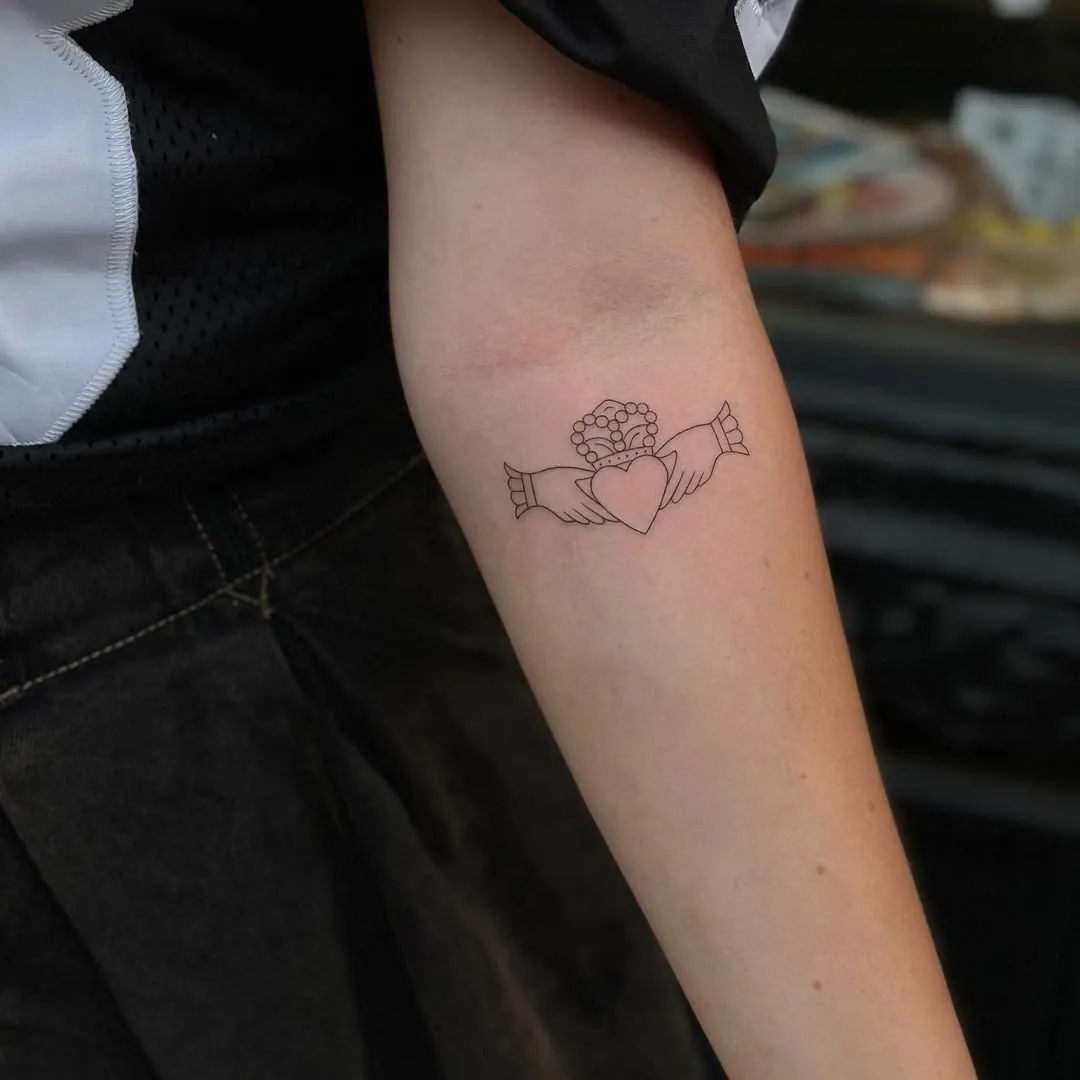
The Claddagh is the Irish symbol people ask us about most. It shows two hands holding a heart, with a crown on top. Each part has its own meaning:
- The hands stand for friendship.
- The heart stands for love.
- The crown stands for loyalty.
The design takes its name from the Claddagh, an old fishing village just outside the walls of Galway city. It dates back to the 17th century. The most popular story behind it is about a Galway man named Richard Joyce. The story goes that he was captured by pirates in the 1670s, sold into slavery, and trained as a goldsmith while he was held abroad. When he was finally freed, he returned to Galway, found the woman he loved still waiting for him, and gave her the first Claddagh ring. Some of the oldest surviving Claddagh rings carry the initials “RJ”.
Whether every detail of the story is true or not, the ring spread across Ireland and then around the world as Irish families emigrated. That’s a big part of why it means so much to the Irish diaspora today. For a lot of our clients from America, Canada and Australia, a Claddagh tattoo is a way of carrying a piece of home.

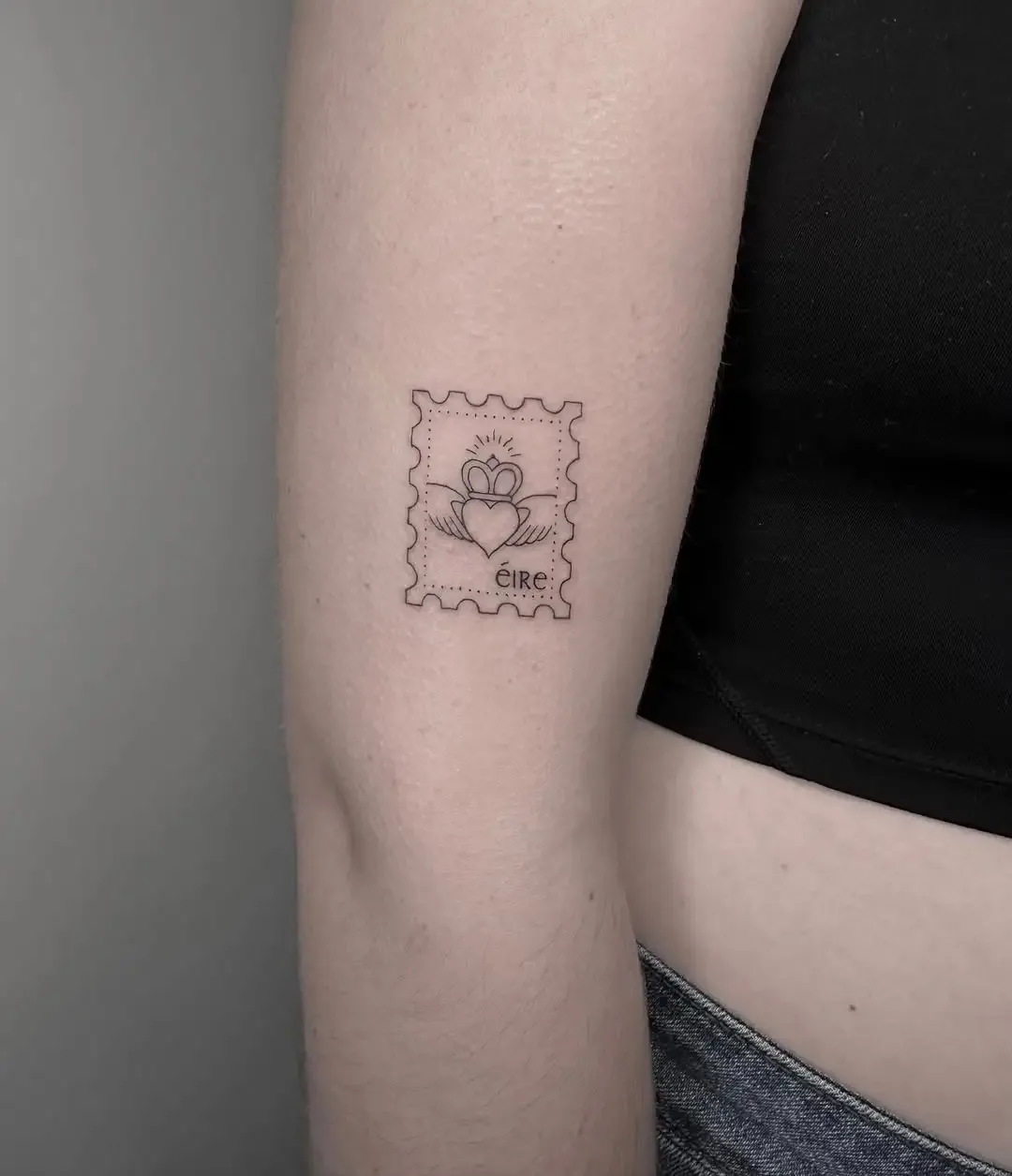
Claddagh postage stamp designs with Éire lettering
Claddagh Tattoo Ideas
Classic fine line outline. Clean, small and timeless. It suits a wrist, ankle, forearm or behind the ear, and it’s one of the most popular first tattoos we do. Read more about the style in our fine line tattoo guide.
The Irish postage stamp. A Claddagh framed as a little stamp with “Éire” lettering, like the pieces above. It’s a favourite with visitors because it reads as “from Ireland” without needing any words.
Claddagh with a name or date. Add initials inside the heart or a date underneath to make it about one person or one moment.
Matching Claddaghs. Partners, best friends, mothers and daughters. Because the symbol covers love, friendship and loyalty, it works for almost any relationship.
Shamrocks and Four-Leaf Clovers
The shamrock is the best-known symbol of Ireland. It’s a young sprig of clover with three leaves. Interestingly, botanists have never fully agreed on which clover is the “real” shamrock, and different plants have been sold as shamrock over the years.
The famous legend says Saint Patrick used the three leaves to explain the Holy Trinity (Father, Son and Holy Spirit): three parts, one plant. The story was first written down in the early 1700s, long after Patrick’s time, but it’s been tied to him and to Ireland ever since. Today the shamrock is worn on St Patrick’s Day all over the world, and it’s a symbol of the whole island.
Three Leaves or Four?
Both. We tattoo three-leaf shamrocks and four-leaf clovers all the time, and both look great. The three-leaf shamrock is the classic symbol of Ireland. The four-leaf clover is the lucky one, rare to find in a field and a favourite for anyone who wants a little “luck of the Irish” to take home. Pick whichever you love.
Shamrock Tattoo Ideas
A tiny shamrock or four-leaf clover on the wrist, finger or behind the ear. Quick to do, and a great walk-in or flash choice.
A shamrock with initials or a date for a family member, especially for people with Irish roots who are visiting for the first time.
A shamrock paired with another small symbol, like a Claddagh, a little heart or a date next to it, if you want to combine two ideas.
Black or green? Black line work is the classic choice and holds its shape very well. Green ink looks great, but lighter colours can heal a little unevenly on some skin. That’s normal and easily fixed, and every tattoo at XOXO includes a free touch-up within 6 months.
Got an Irish Design in Mind?
Send us your idea and we’ll match you with the right artist. Book online or just message us on Instagram, whichever suits you.
Celtic Knots, the Trinity Knot and the Triskele
Celtic knotwork is made from lines that weave over and under each other with no beginning and no end. That unbroken line is a big part of its appeal: people read it as eternity, loyalty and connections that can’t be broken.
The Trinity Knot (Triquetra)
The trinity knot, also called the triquetra, is three interlocking loops drawn from a single continuous line. It appears in early medieval Irish art, including manuscripts from around the time of the Book of Kells, which you can see at Trinity College here in Dublin. For centuries it has been read as a symbol of the Christian Holy Trinity.
The people who carved and painted these knots didn’t leave notes about what they meant, so other readings have grown up too. Today people choose the trinity knot for all sorts of “threes”: past, present and future; mind, body and spirit; or three people in a family. That flexibility is why it’s one of the most popular sibling and family tattoos.
The Triskele (Triple Spiral)
The triskele is three spirals joined at the centre. The most famous Irish example is carved inside Newgrange in County Meath, a passage tomb built around 3200 BC. That makes it older than Stonehenge and the pyramids of Giza, and much older than the Celts themselves.
Nobody knows for certain what it meant to the people who carved it. Modern readings include life, death and rebirth, or the movement of the sun and seasons (Newgrange’s chamber lights up with sunlight at the winter solstice). If you want a symbol that’s ancient, Irish and a little mysterious, the triskele is it.
Other Celtic Knot Designs
The Celtic love knot is two interwoven hearts, a popular choice for couples. Celtic knot bands wrap around the arm or ankle. Knotwork borders can frame another design, like an animal or a name.
More Irish Symbols Worth Knowing
The Celtic cross. A cross with a ring around the centre. Large stone high crosses from the early medieval period still stand at sites around Ireland, and the design is often covered in knotwork. It works well as a larger piece on the back, shoulder or forearm.
The Irish harp. The harp is Ireland’s official national emblem. You’ll find it on Irish euro coins and on the Irish passport. It’s a great choice if you want something clearly Irish that fewer people have.
Dublin itself. City coordinates, the Ha’penny Bridge, a Dublin postcode or a little Luas line. These suit people who love the city rather than the country as a whole, including plenty of people who moved here and made it home.
Getting Celtic Designs Right on Skin
Celtic knots look simple but they’re unforgiving. Every line has to pass correctly over and under the next, and the spaces between lines need to stay open as the tattoo ages. Here’s what we look at when we design one:
Give It Enough Size
Ink spreads very slightly under the skin over the years. If a knot is drawn too small, the gaps between the lines can close up and the knot turns into a blob. Your artist will tell you the smallest size that will still read clearly in ten years.
Keep the Weave Correct
A real Celtic knot alternates over, under, over, under. Copies found online are often drawn wrong. We redraw the design properly so the weave is consistent all the way round.
Choose the Right Placement
Symmetrical knots look best on flat, steady areas: the inner forearm, the back of the neck, between the shoulder blades or the upper arm. Bands suit the forearm, upper arm and ankle. See our pain guide if you’re weighing up spots.
Decide on the Style
Fine line gives a delicate, modern look. Bolder black lines are more traditional and very hard-wearing. Shading or dotwork can add depth to larger pieces. Browse our fine line gallery and black and grey guide to see the difference.
Irish Words and Phrases
A few words in Irish (Gaeilge) can be just as meaningful as a symbol. Some popular ones:
| Irish | Meaning |
|---|---|
| Sláinte | Health, and the Irish toast “cheers” |
| Éire | Ireland |
| Anam cara | Soul friend |
| Mo chroí | My heart |
| Grá | Love |
| Neart | Strength |
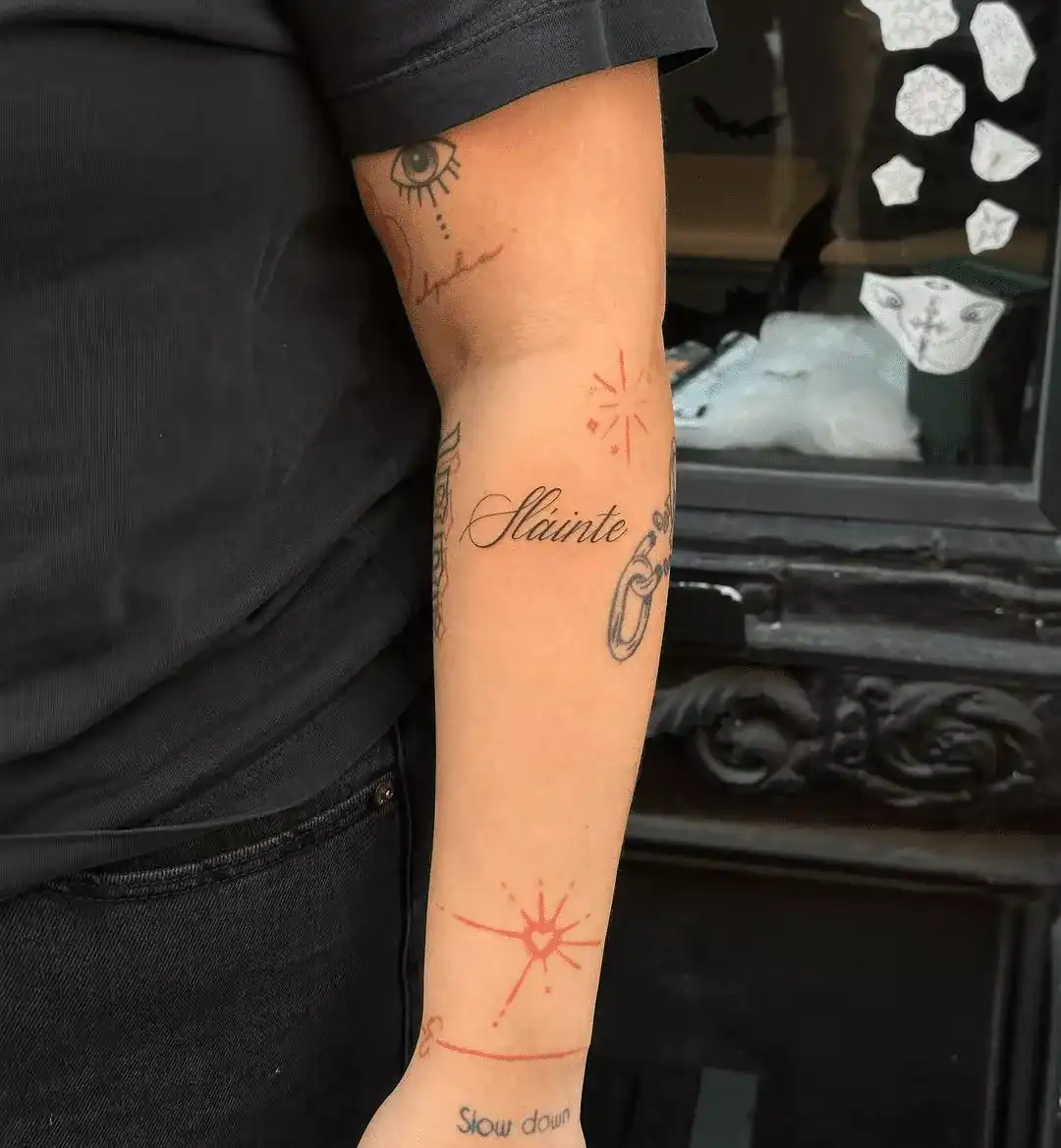
Sláinte in fine line script
Check the Fada
The accent on Irish vowels (the fada, as in Sláinte, Éire and Grá) changes how a word sounds and sometimes what it means. Leaving it out is the most common mistake in Irish-language tattoos. Have the spelling checked by someone who speaks Irish, and send it to us in writing so your stencil matches exactly.
Getting an Irish Tattoo While You’re in Dublin
Lots of our Irish designs are done for visitors. We’re at 112 Capel Street, Dublin 1, a short walk from Temple Bar and O’Connell Street, and we’re open 7 days a week, 12pm to 8pm.
- Book ahead if you can. Send your idea through our booking form or DM us before your trip, so your date is secured.
- Walk-ins are welcome when there’s space. Small Claddaghs and shamrocks are ideal. Here’s how walk-ins work.
- St Patrick’s Day: we’re closed on 17 March. Paddy’s week is busy, so book the days before or after early.
- Plan your healing. Avoid swimming, sunbathing and long baths for the first couple of weeks. Our aftercare guide covers the full routine.
Small Irish tattoos usually start at our €80 minimum. Larger or more detailed pieces, like a Celtic cross on the back, are priced on size and time. Our Dublin tattoo price guide gives you a full breakdown.
If it’s your first one, our first tattoo guide walks you through the whole day, and our small tattoo ideas are a good place to find inspiration for a little companion piece.
Irish Tattoo FAQs
What does a Claddagh tattoo mean?
The Claddagh stands for love, friendship and loyalty. The heart is love, the hands are friendship and the crown is loyalty. It comes from the Claddagh fishing village in Galway and dates back to the 17th century.
Do you tattoo shamrocks and four-leaf clovers?
Yes, both. The three-leaf shamrock is the classic symbol of Ireland, and the four-leaf clover is the lucky one. Both are popular small Irish tattoos, perfect for a first tattoo or a souvenir.
What does the trinity knot mean?
The trinity knot (triquetra) is three loops drawn from one unbroken line. It has long been read as a symbol of the Holy Trinity. Today people also use it for other groups of three, such as past, present and future, or three members of a family.
Can I get an Irish tattoo as a tourist in Dublin?
Yes. We’re open 7 days a week, 12pm to 8pm, at 112 Capel Street. Booking ahead is the safest option, and we take walk-ins when artists have space. Small designs like a Claddagh or shamrock are ideal for a visit.
How much does a small Irish tattoo cost in Dublin?
Small designs start from our €80 minimum. The final price depends on size, detail and placement. Larger pieces are priced on time.
Are you open on St Patrick’s Day?
No, XOXO is closed on 17 March. We recommend booking for the days before or after, as Paddy’s week fills up quickly.
Book Your Irish Tattoo
Claddagh, shamrock, four-leaf clover, Celtic knot or something of your own. 112 Capel Street, Dublin 1. Open 7 days, 12pm to 8pm.
Prefer to see more first? Browse the full gallery.
Leave a Reply